
The Scheduling Problem Nobody Warns You About
A standard wedding planning timeline assumes a generic ceremony structure: guests arrive, processional happens, vows are exchanged, everyone moves to reception. It doesn't account for a ketubah signing, a bedeken, yichud, or the logistics of a rabbi who has another commitment in two hours. Jewish couples — and their planners — end up building the day's schedule largely from scratch, often with limited examples to reference. The elements of a Jewish wedding are well documented; how long each one takes in practice, and how to sequence them around cocktail hour and photos, is much harder to find.
The Ceremony Sequence and Realistic Timing
Here are the main elements of a traditional or Reform Jewish wedding, with honest time estimates:
- Ketubah signing — 15–30 minutes. If the rabbi speaks, makes it ceremonial, or includes musical elements, plan toward the higher end.
- Bedeken (the veiling ceremony) — 5–15 minutes. This often runs longer than expected because it's more emotional than couples anticipate.
- Processional and guests being seated — 15–20 minutes.
- Under the chuppah: hakafot (circling), ring exchange, sheva brachot, breaking the glass — 20–45 minutes. A ceremony with seven rabbis each offering a blessing, musical sheva brachot, or a longer sermon will run toward the higher end. A shorter, less ceremonial ceremony can be done in 20 minutes.
- Yichud (the couple's private time immediately after the ceremony) — 10–20 minutes. This is consistently underestimated. The couple goes into a private room; the room needs to be set up and staffed; guests are transitioning from the ceremony space to cocktail hour. Factor in time for the couple to actually breathe and eat something before entering the reception.
Total ceremony-related time before the reception: roughly 75–130 minutes, depending on how ceremonial each element is and how smoothly transitions go. Most couples find the day runs longer than the coordinator's initial estimate.
How Long Does the Signing Actually Take?
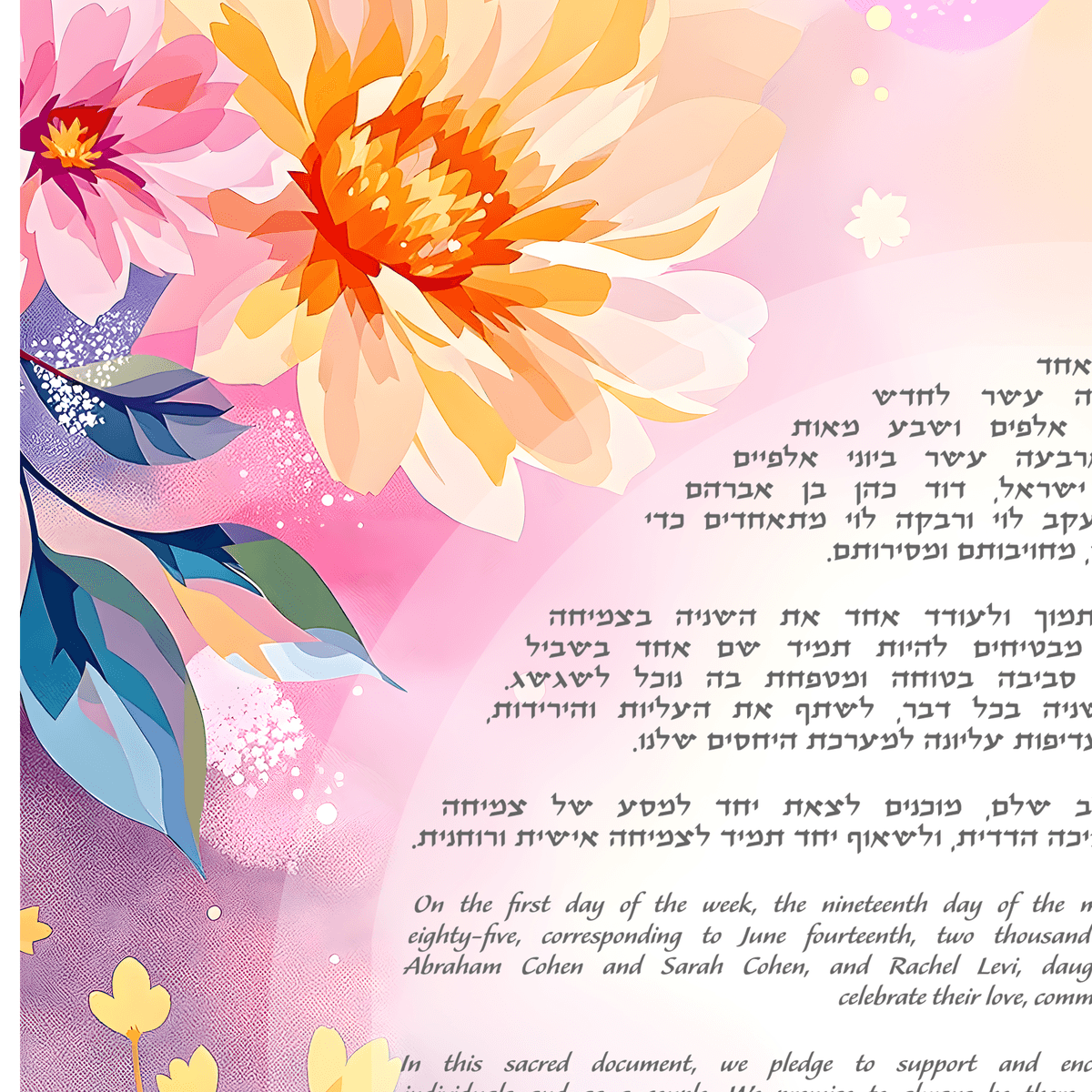
This question comes up regularly, and it's worth being specific: the physical act of signing takes two to three minutes. But the ketubah signing is rarely just the physical act of signing.
A rabbi who explains what the document says, who creates a meaningful moment with the couple, who takes time with the witnesses, or who includes music or brief words — that signing takes closer to 20–30 minutes. A signing that's purely logistical, with no ceremony around it, can be done in five minutes. What your coordinator tells you to budget depends entirely on what you're actually planning to do in that room.
The mistake is treating the signing as a logistical step to check off and then discovering that you and your partner wanted it to feel like something. Decide early whether it's a quiet, private moment with just the witnesses, or a more ceremonial gathering of close family. That decision shapes how much time you actually need — and it should come from you, not from a default slot in a spreadsheet.
Photos, First Look, and What Your Rabbi Actually Requires
One of the most common timeline questions for traditionally-minded couples: can you do a first look — seeing each other and taking photos together before the ceremony — while still having an Orthodox or near-Orthodox wedding?
The honest answer varies by rabbi. In a traditional Orthodox ceremony, the bedeken serves as the first moment the groom sees the bride before they go under the chuppah. A first look changes that sequence. Some Orthodox rabbis consider this a meaningful departure from tradition; others are more flexible, particularly when a first look allows the couple to complete photos before the ceremony, which can actually reduce time pressure later in the day.
If this is relevant to your wedding, raise it directly with your rabbi before finalizing the photographer's timeline. Don't assume in either direction — that a first look is obviously fine, or that it's obviously forbidden. Get your rabbi's actual position and then design the photo schedule around it. A timeline that looks clean on paper but creates friction with your officiant is not actually a good timeline.
Building Your Day's Schedule
A few principles that help when putting the day together:
- Plan around your rabbi's availability first. If your rabbi has another commitment at 4:00 PM, everything works backward from there. Don't build a guest-facing schedule and then try to fit the rabbi into it.
- Add buffer to every Jewish ceremony element. The estimates above are honest, not optimistic. A bedeken that's supposed to take ten minutes frequently takes fifteen because the emotion in the room slows things down — build in time for that.
- Brief your photographer on the Jewish ceremony sequence in advance. A photographer familiar with Jewish weddings knows to be in position before the bedeken; one who isn't may be resetting elsewhere and miss it. A quick briefing the week before solves that problem.
- Use cocktail hour as your buffer. Guests at cocktail hour are eating, drinking, and happy. If the ceremony runs long and they flow into cocktail hour a few minutes late, they generally don't notice. Build for this deliberately rather than hoping everything runs on time.
The elements that make a Jewish wedding day feel like itself — the signing, the bedeken, the chuppah, yichud — are worth protecting with realistic time. The scheduling work is just making sure those moments have room to actually happen the way you want them to.