
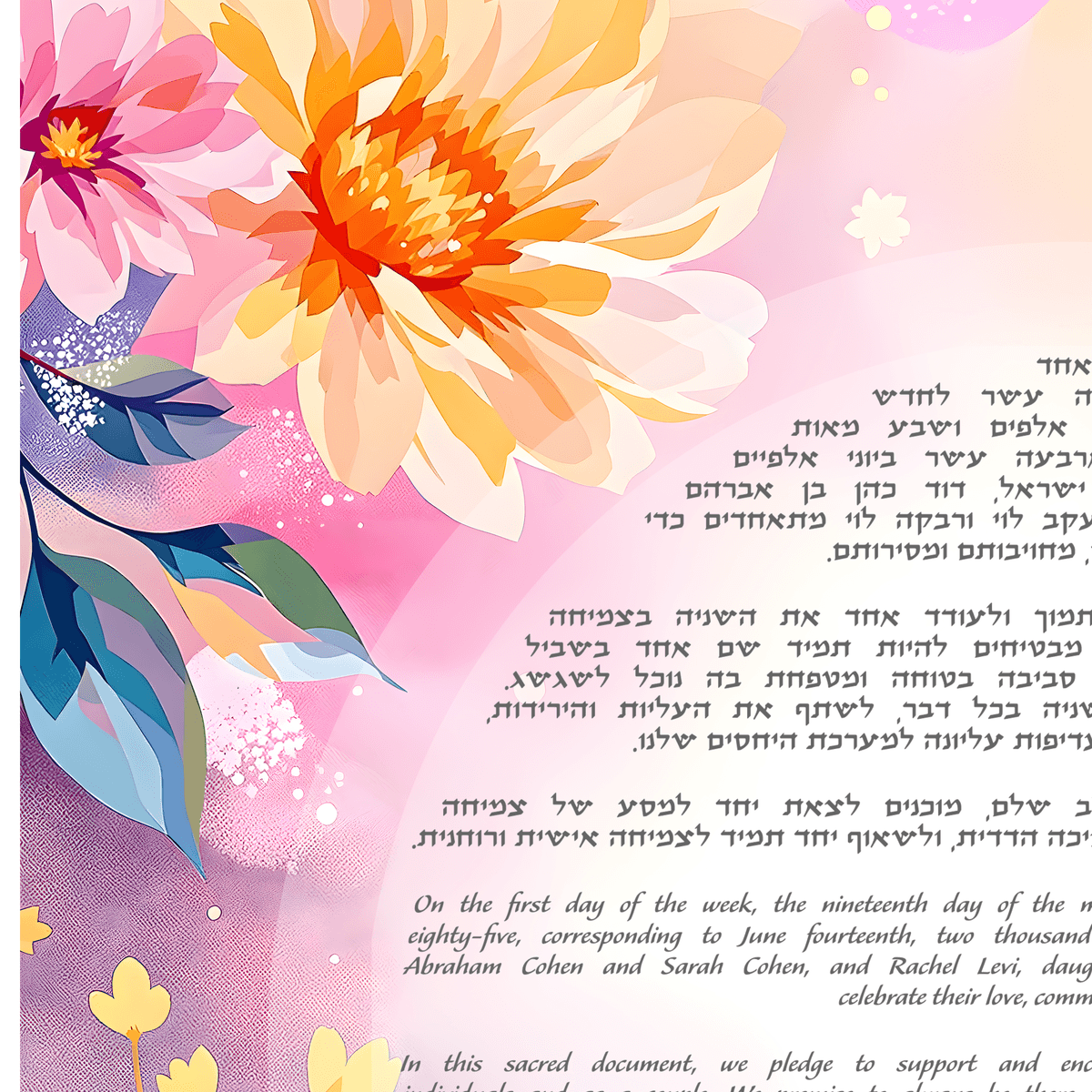
The Default Assumption — and Why It's Not a Rule
Most couples assume the ketubah gets signed in the final stretch before the ceremony — typically during the tisch or kabbalat panim, the hour or so before the chuppah, surrounded by close family and the wedding party. That's the most common pattern, but it's a custom, not a requirement. Once you know that, a lot more flexibility opens up.
Signing at the Rehearsal Dinner
Some couples sign the ketubah a day early, often folding it into a smaller, more intimate rehearsal dinner with family and the bridal party — especially useful if the wedding day itself is large, tightly scheduled, or includes guests the couple would rather not have crowding around during a meaningful, private moment.
Whether this works for you depends partly on denomination and partly on your officiant's preference. In Orthodox and many Conservative practices, the ketubah signing is considered part of the wedding's halachic process and is typically expected to happen on the wedding day itself, close to the ceremony — though there's some flexibility in exactly how close. Reform and Reconstructionist ceremonies generally treat the signing as more symbolic and are often comfortable doing it the day before. The honest answer is to ask your rabbi or officiant directly rather than assume either way — this is exactly the kind of question they're used to fielding, and they'll know what's appropriate for your specific ceremony.
Can You Sign Before the Wedding Day at All?
Yes, in many cases — particularly for couples who want a smaller, quieter signing separate from the main event. Some couples sign at home with their two witnesses days before the wedding, then bring the signed document to be displayed at the ceremony. Again, check with your officiant, since the further out you move the signing, the more it matters which tradition's expectations you're working within.
Public During the Ceremony, or Private Beforehand?
A related decision comes up just as often: should the signing happen privately, with just the couple and witnesses, or as a visible part of the ceremony itself, where guests can watch?
There's no single right answer, and both are common. Traditionally, the signing happens in a separate room before the ceremony — a quiet, focused moment with the couple, two witnesses, and sometimes the officiant, away from the rest of the wedding. Many couples like this because it keeps a contractual, legal moment separate from the more public, ceremonial parts of the day.
Increasingly, though, couples — especially those marrying interfaith or with guests unfamiliar with Jewish tradition — choose to sign the ketubah as part of the ceremony itself, after the rings and before the final pronouncement, so guests can see and understand what's happening rather than missing it entirely. This works particularly well when the officiant briefly narrates the signing for the audience, turning a private legal moment into a shared, explained one.
There's also a middle option some couples like: signing beforehand, but somewhere semi-public — a courtyard, a park, a hotel lobby — so it still feels like part of the day's events even though it isn't broadcast to the full guest list. Some couples even do a brief, informal signing in a public spot they love, just to capture the moment somewhere meaningful without making it a spectacle.
Whichever you choose, let your officiant know in advance — they'll often have a preferred way to handle or narrate the moment depending on whether it's public or private.
When the Ketubah Itself Doesn't Arrive in Time
A separate, more stressful version of timing trouble: the ketubah itself — the physical artwork — doesn't arrive before the wedding. Shipping delays, an artist running behind, customs holds on international orders — it happens more often than couples expect, especially with custom or hand-made pieces.
If you're in this position, you have a reasonable backup option: print a plain version of the text from the proof your artist sent you — even something as simple as a local print shop — and sign that at the ceremony. Once your real ketubah arrives, you can re-sign it with the same witnesses, or in some traditions, simply have it stand as the artistic, "for display" version while the practical version remains the one that's official. There's no harm to the document's validity in doing this; what matters religiously is the act of signing in front of witnesses, not which specific piece of paper it happens on. If you go this route, it's worth telling your officiant ahead of time, since some prefer to be present for any signing, even a backup one.
Choosing Where to Sign
Beyond timing, location is its own decision. Common options include a private room near the ceremony space, a family member's home the night before, or as part of a tisch with food and a small crowd. Quieter settings tend to feel more personal; livelier ones turn the signing into more of a celebration in its own right, with toasts and a crowd of witnesses beyond just the two required ones. Neither is more "correct" — it's worth talking through as a couple what kind of moment you actually want this to be, separate from logistics.
Coordinating With Your Officiant
Whatever you decide, loop your officiant in early rather than presenting a plan after the fact. They'll have specific opinions about timing based on the denomination of your ceremony, and they often have practical suggestions — like which witnesses are eligible, how the document should be worded if you're combining traditions, or how to handle a delayed ketubah — that are easier to plan around with notice than to improvise around the week of your wedding.
The bottom line: the signing matters more than its exact timing, or whether anyone's watching. Build a plan that fits your actual schedule, your comfort with an audience, and your officiant's requirements — and don't be afraid to ask "can we move this" or "can we do this differently." For most couples, the answer is yes.