
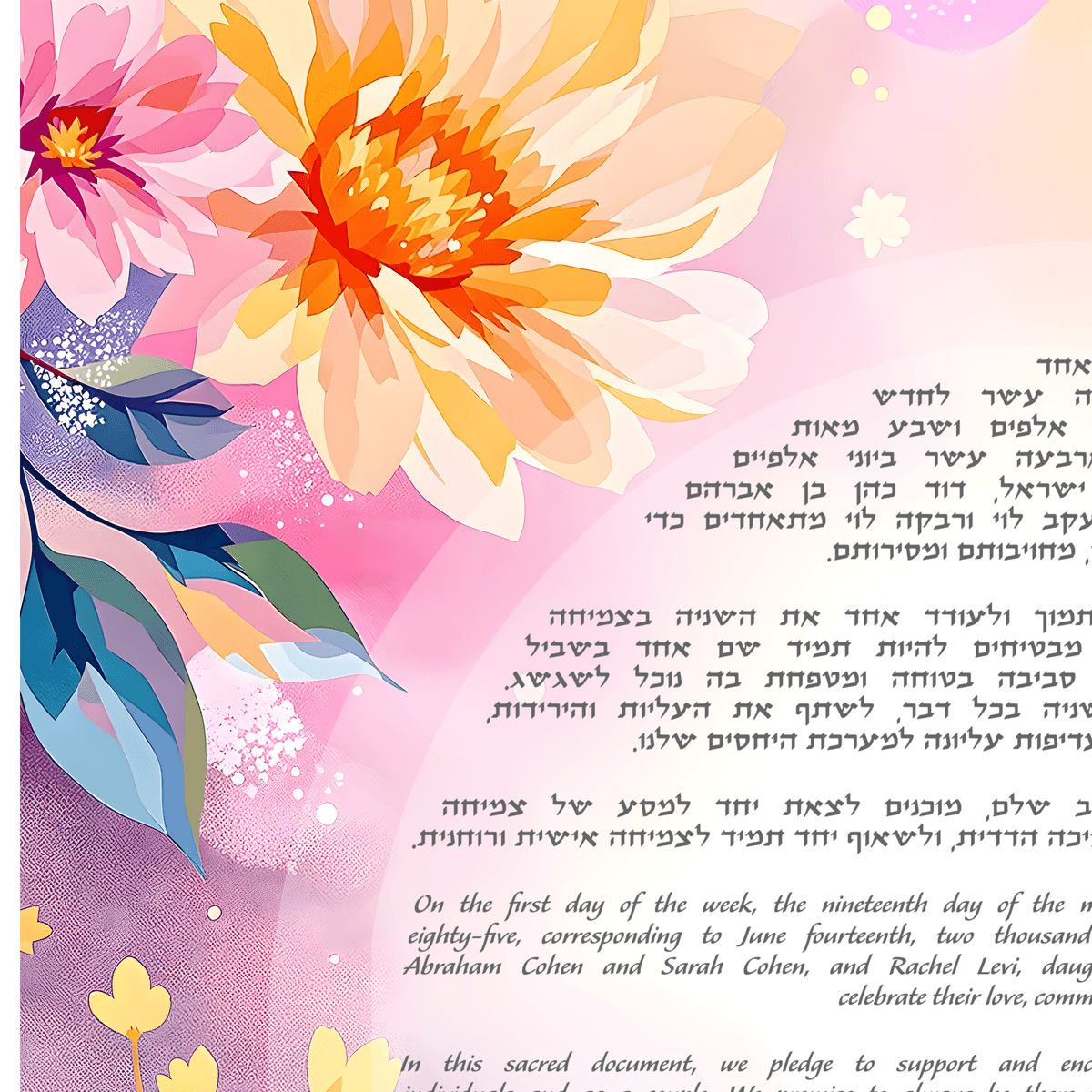
When couples see the phrase "AI-generated art" on a ketubah, it's natural to have questions. Is the AI copying someone's work? Is it ethical? How does a machine create something as personal and meaningful as ketubah artwork?
These are important questions, and they deserve straightforward answers.
How AI Image Generation Works
AI image generation works by converting a text description into an original image. When you type a prompt like "watercolor floral border with pomegranates, olive branches, and warm amber tones on a cream background," the AI model processes those words and generates a composition pixel by pixel.
The model has learned general visual concepts during its training: what "watercolor" looks like as a style, what a pomegranate looks like as an object, how warm amber tones behave against cream backgrounds. It uses this learned understanding of visual language to compose a new, original image that matches your description.
The result is not pulled from a database. It is not a collage. It is not a modification of an existing image. It is a new composition, generated from scratch, that did not exist before you described it.
Our Specific Ethics Commitment
We want to be clear about one specific claim, because it matters:
Our AI is a general-purpose image generation model. We did not train, fine-tune, or teach it using any ketubah artist's designs, portfolios, or artwork.
This distinction is important. Some AI applications involve taking a specific artist's body of work and training a model to replicate their style. That raises serious ethical concerns, and we understand why artists object to it.
That is not what we do. Our AI model is a general-purpose tool that understands visual concepts broadly. It was not shown ketubot. It was not fed any artist's portfolio. When you ask it to create "a mosaic-style border with Jerusalem motifs," it is drawing on a general understanding of mosaics, architecture, and decorative borders, not on any specific ketubah artist's interpretation of those themes.
What This Means in Practice
When you use our design tool, here is what happens:
- You describe your vision. You choose a style (watercolor, papercut, mosaic, modern, etc.) and describe the elements you want: florals, geometric patterns, a specific color palette, cultural motifs, a mood.
- The AI generates original artwork. Based solely on your text description, the model creates a completely new image. If you generate the same prompt twice, you'll get two different images, because each generation is a unique creative act.
- You refine and choose. You can generate multiple options, adjust your description, and pick the artwork that best fits your ketubah.
- The artwork is placed into your ketubah layout. You combine your chosen art with your selected text, names, date, and other personal details to create a finished ketubah.
At no point in this process is an existing artwork referenced, copied, modified, or used as a base.
AI as Democratizing Access
A hand-painted ketubah from a commissioned artist is a beautiful thing. It typically costs between $500 and $2,000, and high-end commissions can exceed that. For couples who can afford it and value the experience of working directly with an artist, that remains a wonderful option.
But not every couple has that budget. Not every couple has access to a ketubah artist in their area. Not every couple has the months of lead time that a commission requires.
AI-generated ketubah art serves these couples. It makes it possible for anyone to have a personalized, beautiful ketubah that reflects their taste and their relationship, regardless of budget or geography. A couple in a small town with no local ketubah artist can design something meaningful at their kitchen table, on their own timeline, for a fraction of the cost of a commission.
This is not about replacing artists. It is about expanding access to a tradition that every Jewish couple deserves to participate in fully.
Coexistence, Not Competition
We believe AI ketubahs and artist-made ketubahs serve different needs, and both have an important place.
Artist-made ketubahs offer a handmade, one-of-a-kind experience. You work with a person who understands your story and translates it into art through their own creative lens. The finished piece carries the artist's hand, their brushstrokes, their interpretation. For many couples, this personal relationship is an essential part of the ketubah's meaning.
AI-generated ketubahs offer speed, affordability, and creative control. You direct the aesthetic. You describe what you want. You iterate quickly. The finished piece reflects your vision, executed by a tool that follows your instructions.
Both are valid. Both produce real ketubahs that couples sign, display, and cherish. The best choice depends on what matters most to you as a couple: the artisan relationship, or the ability to shape the result yourself.
Transparency Matters
We believe in being upfront about how our ketubahs are made. When you design with Diyo/Art, you know exactly what you're getting: AI-generated artwork based on your description, combined with authentic ketubah texts in the tradition of your choice.
We don't pretend the art is hand-painted. We don't obscure the process. We think the technology is genuinely impressive and that the results speak for themselves, and we're happy to explain exactly how it works to anyone who asks.
If you have questions about our AI art process that we haven't covered here, reach out to us. We're always happy to talk about it.
Try designing your ketubah and see the AI art generation in action. You might be surprised by what you and a few well-chosen words can create.