
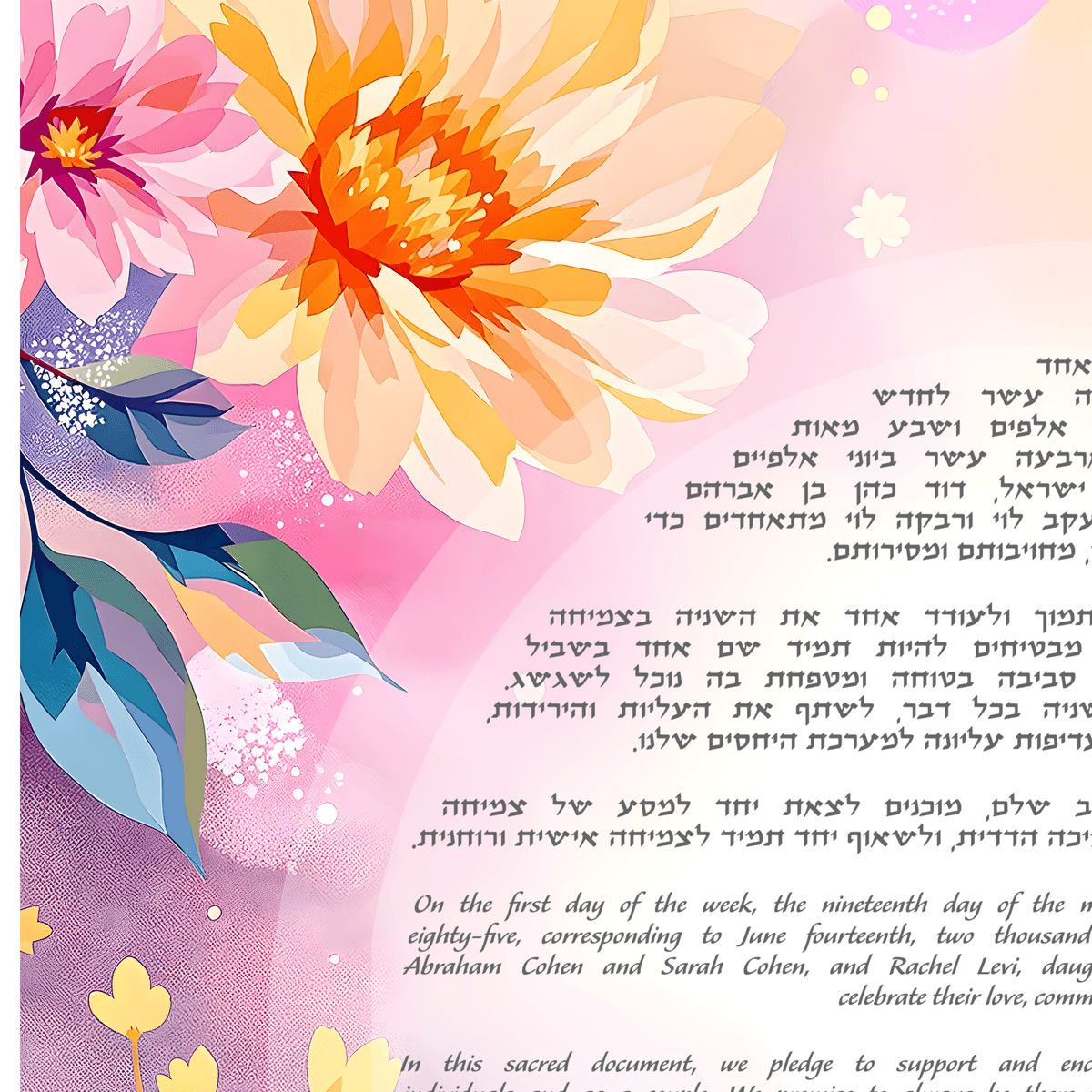
The ketubah is one of the oldest continuously used legal documents in human history. For most of that history, it was a functional text: a contract written on parchment or paper, signed, and stored. But at some point, Jewish communities began to decorate their ketubot, and what started as modest embellishment grew into one of the richest and most distinctive traditions in Jewish art.
This is the story of how a legal document became a work of art, and how technology is writing the latest chapter.
Ancient Origins: The Cairo Geniza
The earliest surviving ketubot come from the Cairo Geniza, a storeroom in the Ben Ezra Synagogue in Old Cairo where the Jewish community deposited worn-out documents for centuries. When scholars began excavating the Geniza in the late 19th century, they found hundreds of thousands of manuscript fragments dating from the 9th to the 19th century, including ketubot from as early as the 10th century.
These early ketubot are strikingly plain. They are legal documents in the purest sense: Aramaic text in neat but unadorned script, written on parchment or paper, with space for signatures and sometimes a date and location. There is little to no decoration. The document's authority came from its words and its witnesses, not from its visual presentation.
Some Geniza ketubot do show simple geometric borders or modest flourishes at the top of the page, but these are exceptions. For the most part, the ketubah of the early medieval period was a text-first document. Its importance was legal, not aesthetic.
Medieval Illuminated Ketubot: The Italian Renaissance
The transformation of the ketubah into an art form began in earnest in medieval and Renaissance Italy. Starting in the 15th century and reaching a peak in the 17th and 18th centuries, Italian Jewish communities produced ketubot of extraordinary beauty. These documents are now among the most prized items in Jewish art collections worldwide, held by institutions including the Israel Museum, the Jewish Museum in New York, and the Biblioteca Palatina in Parma.
Italian ketubot of this era feature:
- Elaborate painted borders. Floral garlands, architectural columns, putti (cherubs), biblical scenes, and allegorical figures surround the text in vivid color.
- Gold leaf and gilt. Many Italian ketubot use real gold leaf, applied by hand, giving them a luminous quality that photographs cannot fully capture.
- Architectural framing. The text is often set within a painted arch or gateway, evoking the entrance to the Temple or the gates of Jerusalem. Columns, pediments, and balustrades drawn from Renaissance architecture frame the document like a miniature building.
- Heraldic devices. Some families included coats of arms or heraldic symbols, reflecting the relatively integrated social position of Italian Jews during certain periods.
- Zodiac and calendar imagery. Symbols of the Hebrew months or zodiac signs sometimes appear, connecting the wedding date to cosmic cycles.
The Italian tradition established the ketubah as a display piece. These ketubot were clearly meant to be seen, not just filed away. They reflect the broader Renaissance conviction that beauty and meaning are inseparable, that a document matters more when it is beautiful.
Regional Traditions: A World of Styles
While Italian ketubot get the most attention in art history, they were not the only decorated ketubot. Jewish communities across the Mediterranean and the Middle East developed their own artistic traditions, each shaped by the visual culture around them.
Sephardic Ketubot from North Africa
Ketubot from Morocco, Tunisia, Algeria, and Libya often feature geometric and arabesque patterns influenced by Islamic decorative arts. Where Italian ketubot use figurative imagery (people, animals, scenes), North African ketubot tend toward abstract pattern work: interlocking shapes, stylized floral motifs, and intricate border designs. Many Moroccan ketubot are written in Rashi script, a distinctive Hebrew cursive that adds visual character to the text itself.
Persian Ketubot
Persian Jewish communities produced ketubot with dense floral patterns, bright colors, and fine line work that reflect the Persian miniature painting tradition. Flowers, birds, and vine scrolls fill every available space. The overall effect is lush and ornamental, quite different from the architectural formality of Italian ketubot.
Yemenite Ketubot
Yemenite ketubot are often more restrained in their decoration, reflecting the relative austerity of Yemenite Jewish life. Decorative elements tend to be calligraphic rather than pictorial, with the beauty of the lettering itself serving as the primary aesthetic element. Some Yemenite ketubot feature modest geometric borders or simple floral accents.
Dutch and Northern European Ketubot
The Sephardic communities of Amsterdam and other Northern European cities produced ketubot that blend Italian influence with Dutch Golden Age aesthetics. These documents sometimes feature engraved borders from copper plates, a technique borrowed from the thriving Dutch print industry. The use of printed borders meant that the decorative frame could be reproduced consistently, with the text filled in by hand for each wedding.
The Modern Revival: 20th Century
By the 19th and early 20th century, the tradition of elaborately decorated ketubot had largely faded. Most ketubot were simple printed forms with blank spaces for names and dates, produced by religious publishers and distributed through synagogues. They were functional and uniform, a far cry from the illuminated manuscripts of Renaissance Italy.
The modern ketubah art revival began in the mid-20th century, driven by several forces:
- The establishment of Israel and the accompanying interest in reclaiming Jewish cultural traditions, including visual arts.
- The feminist movement within Judaism, which encouraged couples to take ownership of the ketubah text and, by extension, its visual presentation.
- The growth of the Jewish art market, with galleries and collectors recognizing the ketubah as a legitimate art form with a rich historical pedigree.
Artists like David Moss, whose ketubot are meticulously hand-painted and gilded in a style that consciously echoes the Italian tradition, helped establish the contemporary ketubah as a serious art form. Other artists brought modernist, abstract, and folk-art sensibilities to the form, expanding the visual vocabulary far beyond historical models.
Mass Production and the Template Era
As demand for decorated ketubot grew, so did the market for affordable options. By the late 20th century, a robust industry of printed ketubah templates had emerged. Artists would create a single design, a print shop would reproduce it in quantity, and couples would purchase a print with their names and details added.
This model made beautiful ketubot accessible to a much wider audience. A couple who could not afford a $1,000 commission could buy a $150 print of a gorgeous watercolor design. The tradeoff was personalization: your ketubah might look identical to dozens or hundreds of others purchased from the same artist.
Template ketubot remain popular and widely available through Judaica shops, online marketplaces like Etsy, and dedicated ketubah websites. They offer a reliable, affordable path to a beautiful ketubah.
The Digital Age: Online Customization
The internet changed the ketubah market in the same way it changed every other creative industry. Online ketubah vendors made it possible to browse hundreds of designs, compare prices, and order from anywhere. Some platforms began offering digital customization tools that let couples modify text, choose from color variations, and preview their ketubah on screen before ordering.
This was an incremental improvement rather than a fundamental shift. The artwork was still created by human artists, and the degree of customization was usually limited to pre-defined options: this border or that border, blue or green, English or Hebrew.
AI Art: The Latest Chapter
AI-generated art represents a genuine departure from everything that came before. For the first time in the ketubah's long history, a couple can describe their vision in words and receive a completely original artwork that has never existed before.
The implications are significant:
- Every design is unique. No two couples receive the same artwork, because no two couples describe their vision in exactly the same way. Even similar prompts produce different results.
- The couple becomes the creative director. Instead of choosing from someone else's designs, you describe what you want. The AI serves your vision, not the other way around.
- Style is unlimited. You are not limited to a single artist's aesthetic. Want a watercolor garden? A geometric mosaic? An impressionist cityscape of Jerusalem? A minimalist abstract composition? All are possible, generated on demand.
- Iteration is instant. If the first result is not quite right, you adjust your description and generate again. The creative process becomes a conversation between you and the tool, refined in real time.
Full Circle: Technology Returns the Ketubah to Its Personal Roots
There is a quiet irony in the trajectory of ketubah art. The earliest ketubot were deeply personal: handwritten documents created for a specific couple on a specific day. Then came mass production, which made ketubot beautiful but generic. Now, AI technology returns the ketubah to its roots as a deeply personal document, one that is created from scratch for each couple, reflecting their own aesthetic, their own words, their own vision of what a marriage commitment looks like.
The Italian Renaissance families who commissioned elaborate painted ketubot were doing something remarkably similar to what modern couples do with AI art tools: they were saying, "This document is important enough to be beautiful, and it should be beautiful in a way that reflects us." The tools have changed. The impulse has not.
From the Cairo Geniza to Renaissance Italy, from mass production to AI generation, the ketubah continues to evolve. What endures through every era is the conviction that the promises we make to each other deserve to be written beautifully, preserved carefully, and displayed proudly.
Create your own chapter in the history of ketubah art. Design a ketubah that is as unique as your relationship, drawing on thousands of years of tradition and the most advanced creative technology available today.