
You have decided you need a ketubah. Now what? A quick search reveals hundreds of options: Etsy shops, independent artists, Judaica stores, online design tools, and everything in between. Prices range from $50 to $2,000. Some vendors offer a single fixed design. Others let you customize everything. How do you navigate all of this?
This guide walks through the factors that actually matter when choosing a ketubah, so you can ask the right questions and make a confident decision.
Art Style: What Speaks to You?
Ketubah art has never been more diverse. Before you start comparing vendors, spend a few minutes figuring out what aesthetic you are drawn to. Here are the major styles you will encounter:
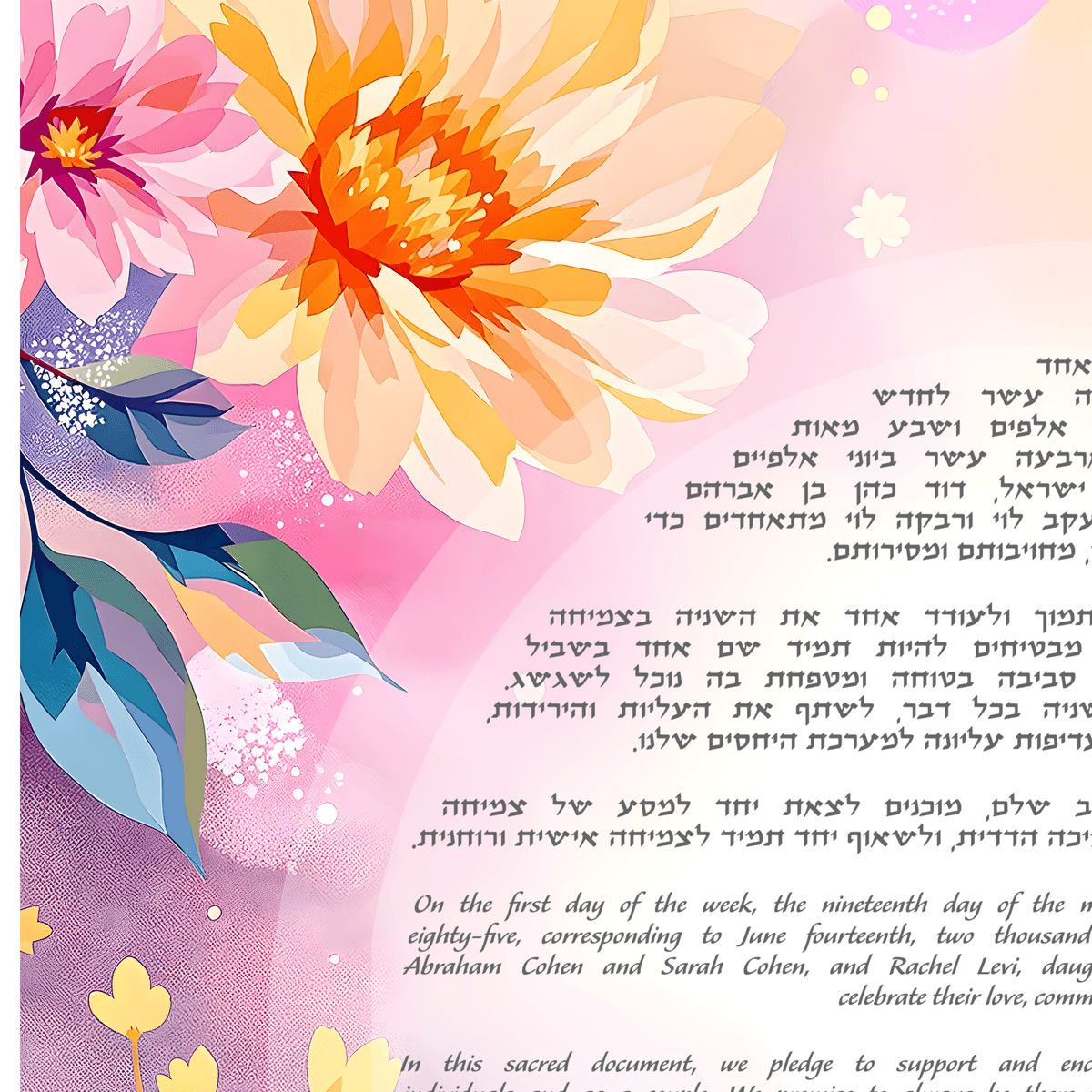
- Watercolor. Soft, organic, painterly. Popular motifs include florals, landscapes, and abstract washes. Watercolor ketubahs feel romantic and timeless.
- Oil painting style. Rich, saturated, textured. These tend to feel more dramatic and museum-worthy. Think deep jewel tones and bold compositions.
- Mosaic. Geometric, structured, inspired by ancient synagogue floors and Byzantine art. Mosaic-style ketubahs often incorporate Jewish symbols like the Star of David, pomegranates, or the Tree of Life in a tessellated pattern.
- Woodblock. Bold lines, high contrast, a handmade folk-art feel. These designs have a graphic quality that photographs beautifully and stands out on a wall.
- Illuminated manuscript. Inspired by medieval decorated ketubot with ornate borders, gold accents, and intricate detail work. This style connects directly to the historical tradition of ketubah art.
- Modern / minimalist. Clean lines, generous white space, contemporary typography. For couples whose home aesthetic leans more toward modern design than traditional ornamentation.
- Papercut. Inspired by the Eastern European Jewish tradition of scherenschnitte (paper cutting). Intricate, lace-like borders with symbolic motifs.
There is no wrong answer here. Your ketubah will hang in your home for decades. Choose a style that you genuinely love looking at, not what you think a ketubah "should" look like.
Text Tradition: Match Your Ceremony and Values
The text is arguably more important than the art, because the text is what you are actually signing. Key questions to ask:
- Does the vendor offer the text tradition that matches your ceremony? If you are having an Orthodox wedding, you need a halakhically valid Orthodox text, and ideally one that matches your specific regional tradition (Ashkenazi, Sephardic, Yemenite, etc.). If you are interfaith, you need a text that welcomes a non-Jewish partner. Do not assume all vendors offer all options.
- Can you read the full text before purchasing? You should never sign a document you have not read and understood. Look for vendors who show the complete text, including both Hebrew and English, before you commit to buying.
- Is the Hebrew accurate? This is hard to evaluate yourself if you do not read Hebrew, but it is critically important. Ask whether the texts have been reviewed by a rabbi or Judaic scholar. Grammatical errors in a ketubah are not just embarrassing; in Orthodox practice, they can affect the document's validity.
Customization: How Much Control Do You Have?
Customization ranges from zero to total across different vendors. Consider what matters to you:
- Text personalization. At minimum, you should be able to enter your names, your parents' names, your wedding date, and your wedding location. Beyond that, can you modify the text itself? Add personal vows? Choose a different translation?
- Art customization. Can you adjust colors to match your wedding palette? Reposition elements? Choose a different border? Or is the design completely fixed?
- Layout control. Can you change the size or orientation? Adjust the balance between art and text? Some couples want a text-heavy ketubah with a subtle border. Others want a full-bleed artwork with text in a small central panel.
- Write-your-own option. If you want to draft your own text, does the vendor support that? Some vendors only sell pre-written templates with no modification allowed.
At Diyo/Art, customization is central to the experience. You control the text, the art (generated from your description), the layout, the colors, and the positioning. But not every couple wants that level of control. If you prefer to choose from curated options and not think about layout, a vendor with beautiful fixed designs might be a better fit for you.
Print Quality: Will It Last?
A ketubah is a lifetime document. The print quality needs to match that expectation. Questions to ask:
- What paper or canvas is used? Look for archival-grade materials. For paper, acid-free is essential. For canvas, ask about the coating and stretch quality.
- What ink technology? Pigment-based inks last far longer than dye-based inks. Giclée printing (high-resolution inkjet with pigment inks) is the standard for fine art reproduction.
- What resolution? Your ketubah should be printed at 300 DPI or higher. Lower resolution prints may look fine from across the room but will show visible pixelation up close, especially in text areas.
- How does it ship? Paper prints should ship flat or in a tube. Canvas should ship stretched and ready to hang, or clearly labeled as unstretched if that is the vendor's model.
Proofing: Can You Preview Before Buying?
Never buy a ketubah sight unseen. You should be able to see exactly what your finished ketubah will look like, with your names, your date, and your chosen text, before you pay for a print.
Look for vendors that offer a digital proof. Even better, look for tools that let you preview in real time as you make changes. The ability to share a proof with your rabbi before ordering is invaluable. Many rabbis want to review the text, and catching a spelling error in a digital preview is much better than catching it on a printed and framed document.
Price Transparency: What Are You Paying For?
Ketubah pricing varies enormously, and the reasons are not always obvious. Here is a rough breakdown of what drives cost:
- Original hand-painted art: $500 to $2,000 or more. You are paying for an artist's time, skill, and creative labor. This is a commissioned piece of fine art.
- Artist-designed printed ketubahs: $150 to $500. The artist created the design once, and it is reproduced as a print. You are paying for the artist's design work, the print quality, and text personalization.
- Online design tools: $50 to $250. You are paying for the technology, the print, and the shipping. The lower price reflects the fact that the art is generated or templated rather than hand-created.
None of these price points is inherently better or worse. They reflect different value propositions. What matters is that you understand what you are getting and that the quality matches the price.
Questions to Ask Any Vendor
Before you buy, ask these questions:
- Is this design exclusive to me? With printed designs, multiple couples may have the same artwork. With custom or AI-generated designs, each one is unique. Neither is wrong, but know which you are getting.
- Can I make corrections after purchase? Ask whether the seller allows corrections after purchase. Mistakes happen — a misspelled name, a wrong date — and you don't want to pay full price again for a fix. Some providers lock the file completely after sale, while others allow text corrections or re-downloads.
- What is the return or reprint policy? Ketubahs are personalized documents, so most vendors do not accept returns. But a good vendor will reprint if there is a production error on their end.
- How long does production and shipping take? If your wedding is in three weeks, you need a vendor who can deliver on that timeline. Ask about rush options if you are short on time.
- Is the text reviewed for accuracy? Especially for Orthodox texts, ask whether a rabbi or scholar has verified the Hebrew and Aramaic.
Choosing a ketubah is one of the most personal decisions in your wedding planning. Take the time to find one that fits your values, your aesthetic, and your budget. The right ketubah will feel like it was made for you, because it was.
Explore Diyo/Art's design tool and see what is possible when you have full control over your ketubah's text, art, and layout.