
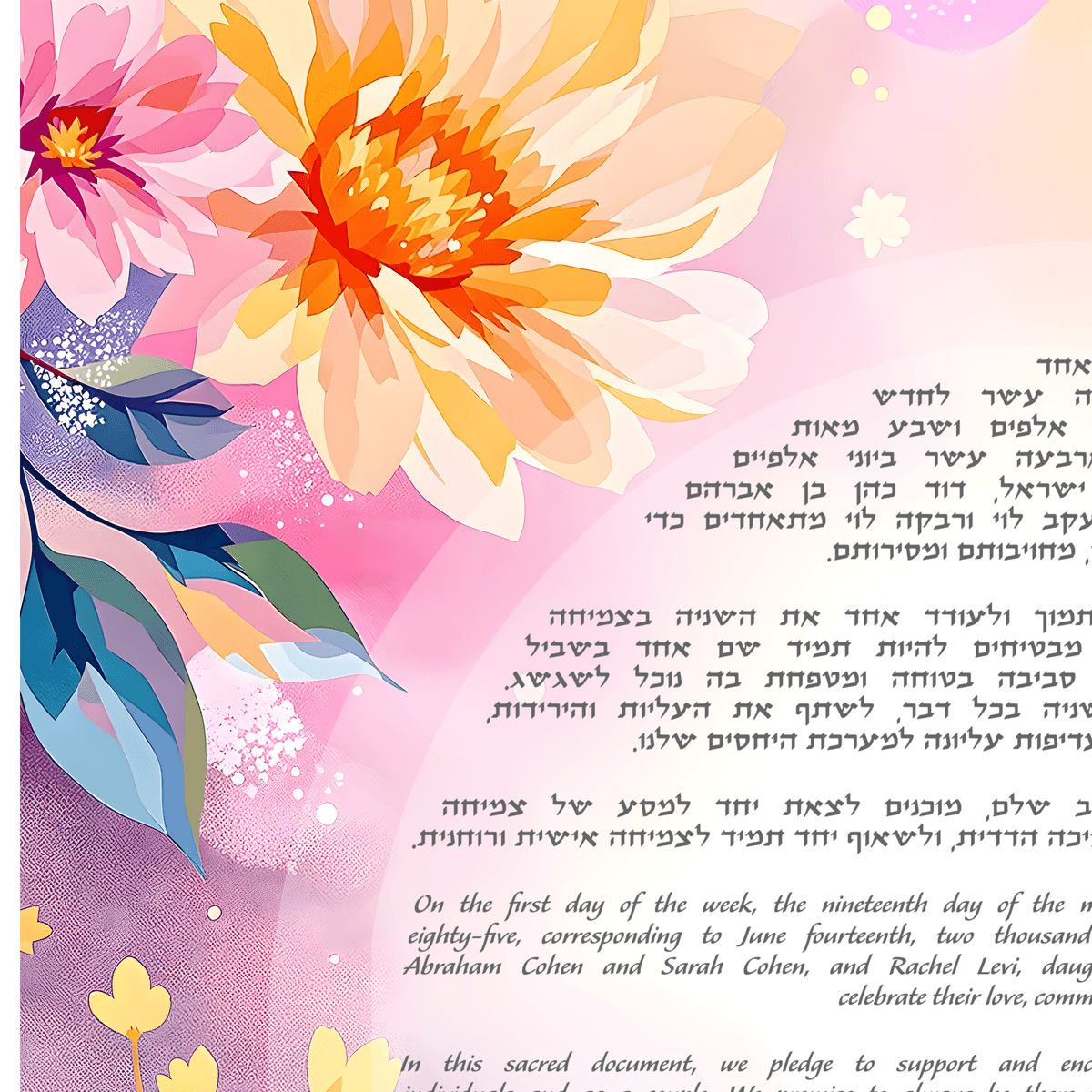
If you're planning a Jewish wedding, you've probably heard the word ketubah (plural: ketubot). You may have seen one hanging in your grandparents' home, or watched one read aloud at a friend's ceremony. But what exactly is a ketubah, and why has it endured for over two thousand years?
The Basics: A Jewish Marriage Contract
At its core, a ketubah is a Jewish marriage contract. The word comes from the Hebrew root k-t-v, meaning "to write." It is a written document that outlines the obligations a couple takes on when they marry. Traditionally, these obligations were primarily from the groom to the bride, but modern ketubot often reflect mutual commitments.
The ketubah is signed before the wedding ceremony, typically during a private signing session called the tish (in Ashkenazi tradition) or a similar gathering. Two witnesses sign the document, and it is then read aloud under the chuppah (wedding canopy) as part of the ceremony.
A Brief History: One of the Oldest Legal Protections for Women
The ketubah is one of the earliest known legal instruments designed to protect women's rights. Its origins stretch back over 2,000 years to the Second Temple period. The Talmud attributes its formalization to Shimon ben Shetach, a rabbinic leader in the 1st century BCE, though marriage contracts existed in the ancient Near East even earlier.
The core purpose was revolutionary for its time: it guaranteed that a woman would receive financial support if her husband died or divorced her. In an era when women had few independent legal rights, the ketubah ensured that marriage was not merely a transfer of property but a binding agreement with real consequences.
Over the centuries, different Jewish communities developed their own ketubah traditions. Sephardic communities in Spain, North Africa, and the Middle East developed distinct texts and artistic styles. Ashkenazi communities in Central and Eastern Europe created their own standards. Italian Jewish communities produced some of the most elaborately decorated ketubot in history, many of which are now museum pieces.
What Goes Into a Ketubah?
A traditional ketubah contains several essential elements:
- Date: The Hebrew date of the wedding, including the day of the week, day of the month, month, and year according to the Jewish calendar.
- Location: The city or town where the wedding takes place, often including a reference to the nearest river or body of water (a traditional geographic identifier).
- Names of the couple: The Hebrew names of both partners, including their parents' names. In Orthodox texts, the father's name is used; in egalitarian texts, both parents may be listed.
- Obligations: The commitments being made. In traditional texts, this includes financial provisions such as the mohar (bride price) and the amount the groom pledges in the event of divorce or death. Modern texts may replace or supplement these with emotional, spiritual, and mutual commitments.
- Witnesses: The signatures of two valid witnesses. In Orthodox practice, these must be observant Jewish men who are not related to the couple. Liberal movements have broadened who can serve as a witness.
- Kinyan: A record that a formal act of acquisition (kinyan) took place, symbolizing the groom's acceptance of the obligations. This is traditionally done by the groom lifting a handkerchief or cloth.
From Legal Document to Art
For most of its history, the ketubah was a purely functional legal document. But beginning in the Middle Ages, Jewish communities began to decorate their ketubot with elaborate artwork. Some of the earliest decorated ketubot come from medieval Italy, where Jewish artisans incorporated Renaissance-era motifs, architectural elements, and biblical scenes.
Sephardic communities produced stunning ketubot with geometric patterns, arabesques, and calligraphy influenced by Islamic art traditions. Some Moroccan ketubot were written in ornate Rashi script and featured intricate borders. Persian ketubot often included floral motifs and bright colors.
By the 20th century, the ketubah had become a recognized art form. Couples began commissioning original artwork, and ketubah artists emerged as a distinct creative profession. Styles range from traditional papercut designs to modern abstract paintings, from watercolor florals to architectural illustrations of Jerusalem.
Today, a ketubah is often the first piece of art a couple purchases together, and it hangs in their home as both a legal document and a daily reminder of their commitment.
Modern Ketubot: Digital Design, AI Art, and Personalization
The ketubah world has evolved dramatically in recent years. While hand-painted ketubot from commissioned artists remain popular (and can cost anywhere from $500 to $2,000 or more), new technology has opened up possibilities that previous generations couldn't have imagined.
Digital design tools allow couples to customize layouts, fonts, and artwork without needing artistic training. AI-generated art makes it possible to describe your vision in words and receive a completely original image tailored to your aesthetic. You might describe "a watercolor garden with pomegranates and olive branches in blues and golds" and receive artwork that has never existed before, created from your description alone.
These tools don't replace traditional ketubah artists. They serve a different need: making personalized, beautiful ketubot accessible to couples at every budget, and giving every couple the ability to create something that truly reflects who they are.
Who Needs a Ketubah?
In Orthodox Judaism, a ketubah is an absolute requirement for a valid marriage. A wedding cannot proceed without one, and if a ketubah is lost, a replacement (ketubah d'irkhata) must be written.
But the ketubah has been embraced far beyond Orthodox circles:
- Conservative Judaism requires a ketubah, typically using the Lieberman clause (an addition that addresses the problem of a spouse refusing to grant a divorce).
- Reform Judaism widely uses ketubot, often with English or bilingual texts that emphasize mutual commitment and egalitarian values.
- Reconstructionist and Renewal communities use ketubot with creative, personalized texts.
- Interfaith couples often choose a ketubah with universal language that honors Jewish tradition while welcoming a partner of another faith.
- Same-sex couples use ketubot with gender-appropriate Hebrew language and egalitarian commitments.
- Secular couples with Jewish heritage may choose a ketubah as a meaningful cultural connection, even without a religious ceremony.
In short, if you're having a Jewish wedding of any kind, a ketubah is almost certainly part of the picture. And increasingly, couples from all backgrounds are drawn to the beauty and intentionality of putting their commitments in writing.
Ready to Design Yours?
Whether you want a traditional Orthodox text in Aramaic or a fully custom English poem, whether you envision classic Jerusalem stone or wildflower watercolors, your ketubah should be as unique as your relationship.
Start designing your ketubah with Diyo/Art's free design tool. Choose your text tradition, enter your names and wedding details, generate original AI artwork, and create a ketubah that you'll be proud to sign and display for a lifetime.