
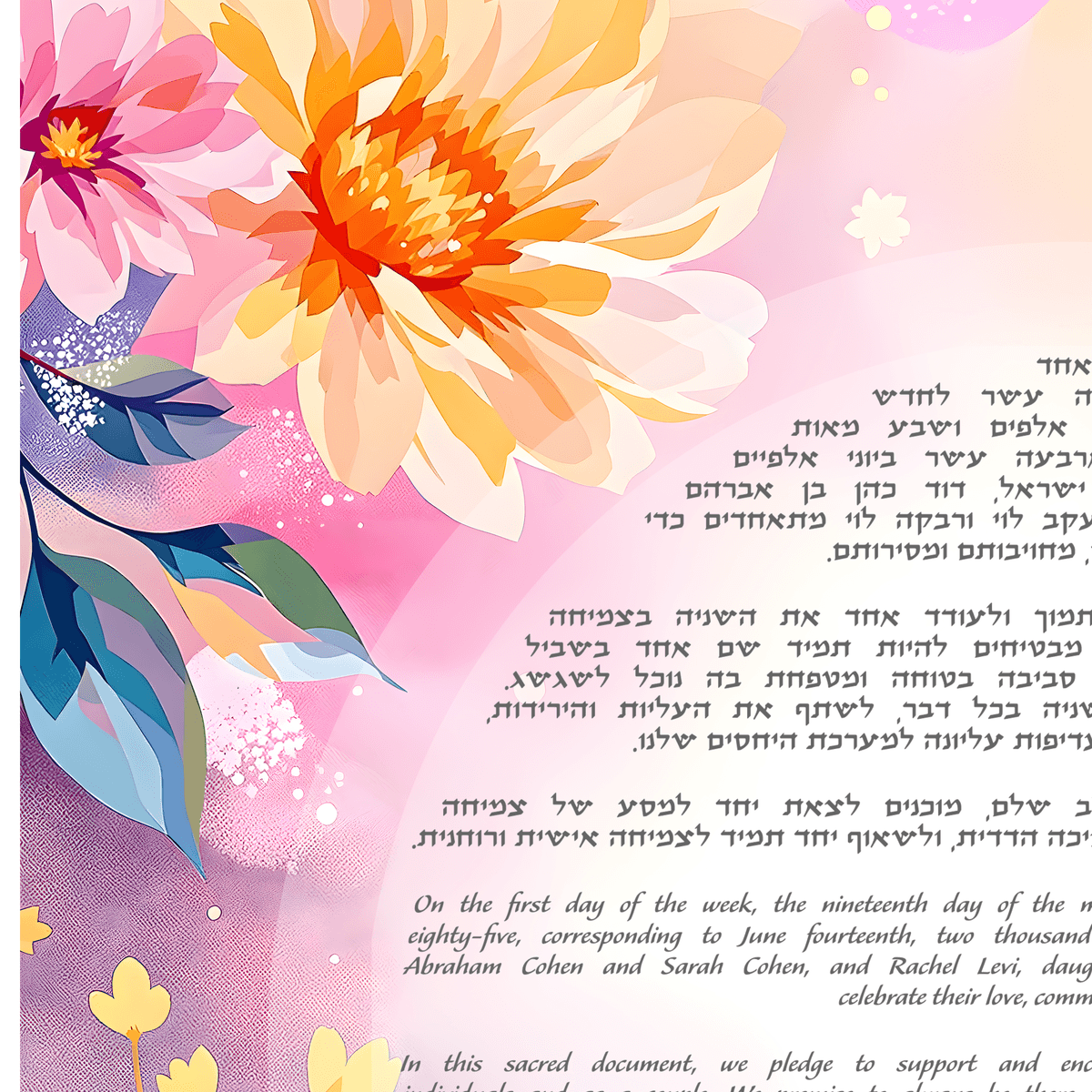
How Names Traditionally Work on a Ketubah
The traditional ketubah text introduces each partner by name: so-and-so, son (or daughter) of so-and-so — using Hebrew names throughout. For the groom, it typically reads: "[groom's Hebrew name], son of [father's Hebrew name]." For the bride: "[bride's Hebrew name], daughter of [father's Hebrew name]." Many egalitarian texts now include the mother's name as well — "daughter of [father] and [mother]" — and this is becoming common even in more traditional contexts. The basic structure is the same: the couple is identified by their Hebrew names and their parentage.
For couples where both partners come from straightforward Jewish backgrounds with Hebrew names, the fields fill in simply. The complexity begins when they don't.
When the Father Isn't Jewish
This is one of the most commonly asked questions about ketubah text — and one of the most variable answers. If you have a Jewish mother but a non-Jewish father, what goes in the "son of" field?
Rabbis genuinely differ on this, and getting four different answers from four different rabbis is not unusual. The options that come up most often:
- "Son of Avraham Avinu" (son of our father Abraham). This phrasing, typically used for converts, is sometimes applied when the biological father isn't Jewish — framing the partner as standing within the Jewish tradition regardless of their father's background. Some rabbis prefer this precisely because it sidesteps an awkward family situation while placing the person within the Jewish story.
- The mother's Hebrew name instead. Some rabbis and texts use "son/daughter of [mother's Hebrew name]" or shift the parentage reference entirely to the Jewish parent. This is common in Reform and egalitarian contexts where the mother's name is already included.
- The maternal grandfather's name. If the person was raised Jewish through their mother's line, some rabbis use the maternal grandfather's Hebrew name to connect the chain of Jewish lineage.
- A transliteration of the father's English name. Some rabbis simply render the father's name phonetically in Hebrew letters rather than using a Hebrew name that doesn't exist. This is the most practical approach and requires no additional decision.
The short answer: raise this question early with your officiant. There is no single halachically mandated answer across all denominations, and your rabbi's convention will ultimately shape what goes in that field.
Including a Stepparent
If a stepparent raised you and you want their name included, this is possible — and more common than most couples realize. One approach is adding the stepparent as a third parent in the parentage line, which some vendors and rabbis accommodate by structuring it as "son of [biological father] and [stepfather]" or including brief additional language. A rabbi's assessment that it's acceptable but not something they've seen often is a reasonable summary of where most denominations land: it isn't standard, but it isn't forbidden, and if it matters to you, most rabbis will work with you to find language that feels right.
If your biological father is deceased and a stepparent has been the primary father figure for decades, rabbis often approach the request with particular openness. The ketubah naming your parents is meant to reflect who you are, not just the biological record.
Adopted Children and Converts
If you were adopted by Jewish parents and were either converted at birth or raised Jewish from infancy, most movements treat your adoptive parents as your halachic parents for all purposes, including the ketubah. Using your adoptive parents' Hebrew names in the "son/daughter of" field is generally straightforward in Reform, Conservative, and Reconstructionist contexts — you are their child, and the ketubah reflects that.
Orthodox practice on adoption is more variable. Some Orthodox authorities use "son/daughter of Avraham and Sarah" for adopted converts — the traditional formulation for anyone who entered the Jewish people through conversion. Others work with families individually to find language that acknowledges both the adoption and the adoptive parents' Jewish standing. This is another question best raised directly with the rabbi who will be officiating your ceremony rather than resolved in advance by assumption.
When a Parent Has No Hebrew Name
If your parent is not Jewish and has no Hebrew name at all, the most practical option is a phonetic transliteration of their English name into Hebrew letters — it puts their actual name on the document without requiring a Hebrew name they don't have. Alternatively, as noted above, some rabbis use the Avraham Avinu convention or shift the parentage reference to the Jewish parent. What typically doesn't happen is leaving the field blank or using a placeholder. Work out what goes there before you're reviewing the final proof so there are no surprises.
The Practical Takeaway
Parent names on a ketubah are one of those areas where practice varies significantly — not just between denominations but between individual rabbis within the same denomination. Raise the question early with whoever is officiating your ceremony and whatever vendor is producing the ketubah. Most vendors follow the instructions your rabbi provides, and most rabbis have a convention they prefer. If a particular approach matters to you — including a stepparent, acknowledging a non-Jewish parent by their actual name, or using the Avraham Avinu formulation — saying so early gives everyone time to find language that works before you're signing off on the final proof.