
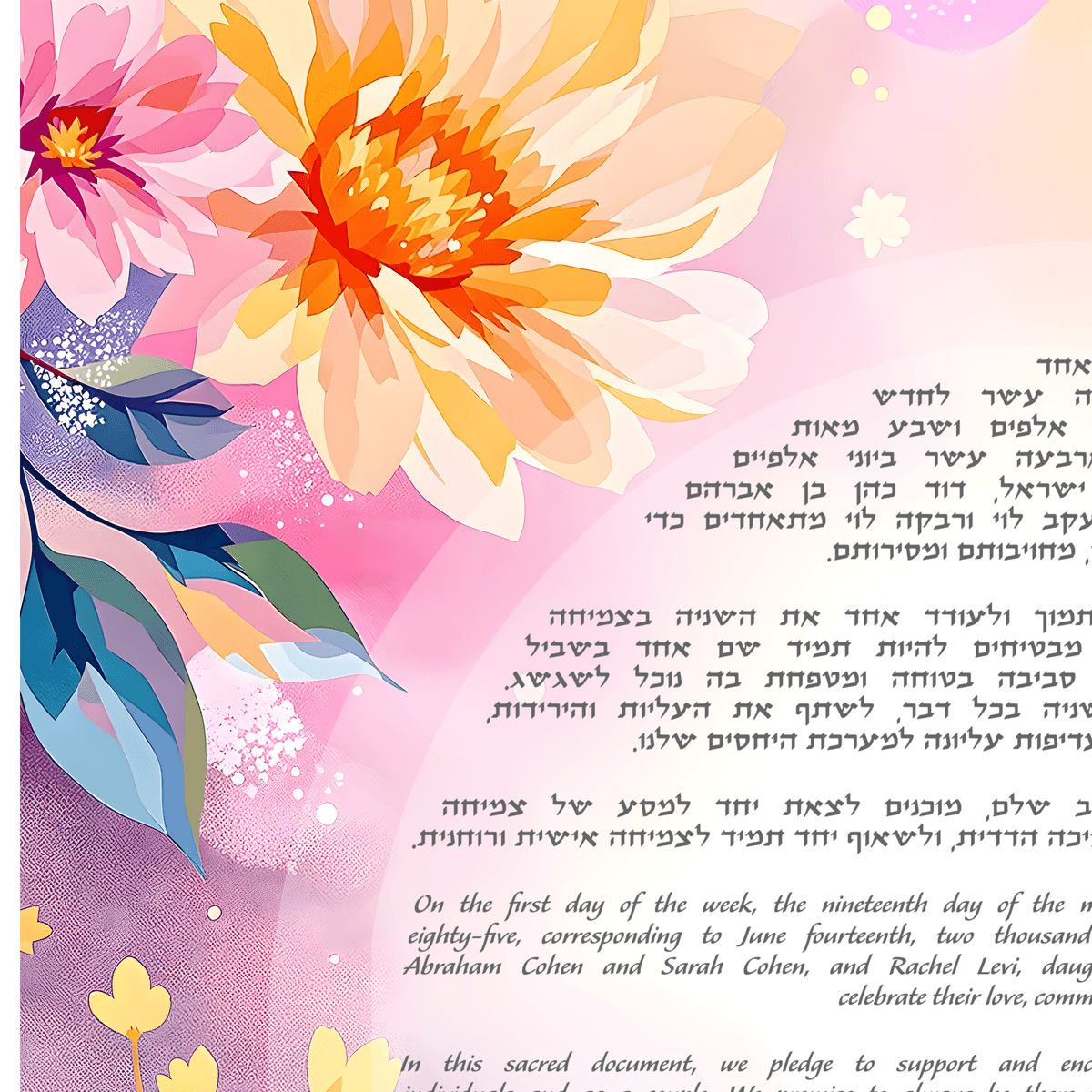
The ketubah has been part of Jewish life for over two thousand years, but Jewish life itself has never been monolithic. Today, roughly half of Jewish Americans who marry choose a partner of a different faith. Many couples identify as culturally Jewish but not religiously observant. Same-sex couples, who were excluded from traditional texts for centuries, now sign ketubahs at weddings across the world.
All of these couples deserve a ketubah that feels honest. A document you sign on the most important day of your life should reflect what you actually believe, not force you into language that doesn't fit. Here is a clear guide to the options available beyond traditional Orthodox and Conservative texts.
The Spectrum: From Non-Denominational to Fully Secular
Think of ketubah texts on a spectrum. On one end, you have traditional Orthodox texts in Aramaic with specific halakhic (Jewish legal) content. On the other end, you have fully secular texts with no religious language at all. In between, there are several meaningful stopping points.
Non-Denominational
A non-denominational ketubah uses broadly Jewish language without aligning with any specific movement. It is fully Jewish in tone and content but avoids the technical legal language of Orthodox texts.
A typical non-denominational text might include a line like:
"With God as our witness and the laws of Israel as our guide, we enter into this sacred covenant."
This text mentions God, references the laws of Israel, and uses the word "sacred." It feels Jewish. It is comfortable for most couples where both partners are Jewish, regardless of whether they affiliate with a particular denomination. If you want a ketubah that sounds traditional without committing to a specific halakhic framework, this is often the right choice.
Interfaith
An interfaith ketubah is designed for couples where one partner is not Jewish. The key change is removing language that assumes both partners are bound by Jewish law.
In practice, the interfaith text keeps references to God but removes the phrase "laws of Israel." A representative line might read:
"With God as our witness, we enter into this sacred covenant."
The logic is straightforward: a non-Jewish partner may believe in God or a higher power, and may deeply value the spiritual dimension of the commitment. But asking them to pledge themselves to the "laws of Israel" would be inauthentic. The interfaith text respects both partners by keeping the spiritual framework while removing the specifically Jewish legal one.
Many interfaith couples are surprised to learn that a ketubah is an option for them at all. It absolutely is. The ketubah tradition is broad enough to welcome you, and a document that honors the Jewish partner's heritage while respecting the other partner's identity is a beautiful thing to sign together.
Secular
A secular ketubah removes all religious language. No God, no "sacred," no "laws of Israel." The text focuses purely on the couple's commitment to each other as a human, personal, and emotional act.
A secular text might begin simply:
"We enter into this covenant."
No qualifiers. No invocations. Just two people making a promise. The rest of the text typically covers mutual commitments: to support each other, to build a home together, to face life's challenges as partners. The language is warm and intentional, but it draws its weight from the couple's own relationship rather than from theology.
Secular ketubahs are popular among couples who identify strongly with Jewish culture and community but do not hold religious beliefs. They want the tradition, the art, the ceremony, the signed document hanging in their home. They just don't want to sign something that invokes a God they don't believe in. That is a perfectly reasonable position, and a secular ketubah honors it fully.
Same-Sex Couples: No Separate Texts Needed
Traditional ketubah texts use gendered Hebrew throughout: the groom does this, the bride does that, with verbs conjugated accordingly. Many ketubah providers handle same-sex couples by offering entirely separate text templates.
Our approach is different. When you indicate the genders of both partners in our design tool, the system automatically conjugates all Hebrew verbs, nouns, and pronouns to match. Two grooms? The Hebrew adjusts. Two brides? Same thing. You use the same meaningful text as any other couple, with the grammar handled behind the scenes.
This matters because it means same-sex couples are not shunted into a separate, lesser version of the text. You get the full text in the tradition of your choice, whether that is non-denominational, interfaith, secular, or any other option, with correct Hebrew grammar throughout.
Write Your Own
If none of the templates say what you want to say, you can write your own ketubah text from scratch. You can also start from any existing template and modify it: change a phrase here, add a personal vow there, remove a line that doesn't resonate.
Some couples write their own vows into the ketubah. Others include a favorite poem, a passage from a book that matters to them, or a quote from Jewish wisdom literature that they connect with personally rather than religiously. One couple might include a line from Song of Songs. Another might quote Mary Oliver.
Your ketubah is your document. It should sound like you.
Why a Ketubah Matters Beyond Religion
Even if you are not religious, a ketubah serves a purpose that no other wedding element quite matches. The ceremony is spoken and ephemeral. The rings are symbolic but silent. The ketubah is the one tangible record of what you promised each other, in writing, in your own words or in words you chose with care.
It becomes a family heirloom. Your children may read it one day. Your grandchildren may see it hanging on your wall and ask what it says. It is a physical artifact of the most important commitment you have made, and that gives it power regardless of whether God is mentioned in it.
Many secular and interfaith couples tell us that designing their ketubah was one of the most meaningful parts of their wedding planning, precisely because it forced them to articulate what they actually promise each other. Not what tradition dictates. Not what a rabbi suggests. What they mean, in their words.
Start designing your ketubah and explore every text option, from traditional Orthodox to fully secular, with same-sex support built in and full freedom to customize.