
The Three Types of Custom Ketubah
The word “custom” covers a wide range in the ketubah market. Knowing what you're actually buying changes what to expect from the ordering process, the price, and the timeline.
Personalized Prints
This is the most common option. You choose from a vendor's catalog of designs, submit your details (Hebrew names, wedding date, text tradition), and receive a finished piece with your information worked into the text. The artwork is shared across many orders, and the text is unique to you. Most established vendors in roughly the $150 to $400 range work this way, with turnaround times of about two to three weeks.
AI-Generated Designs
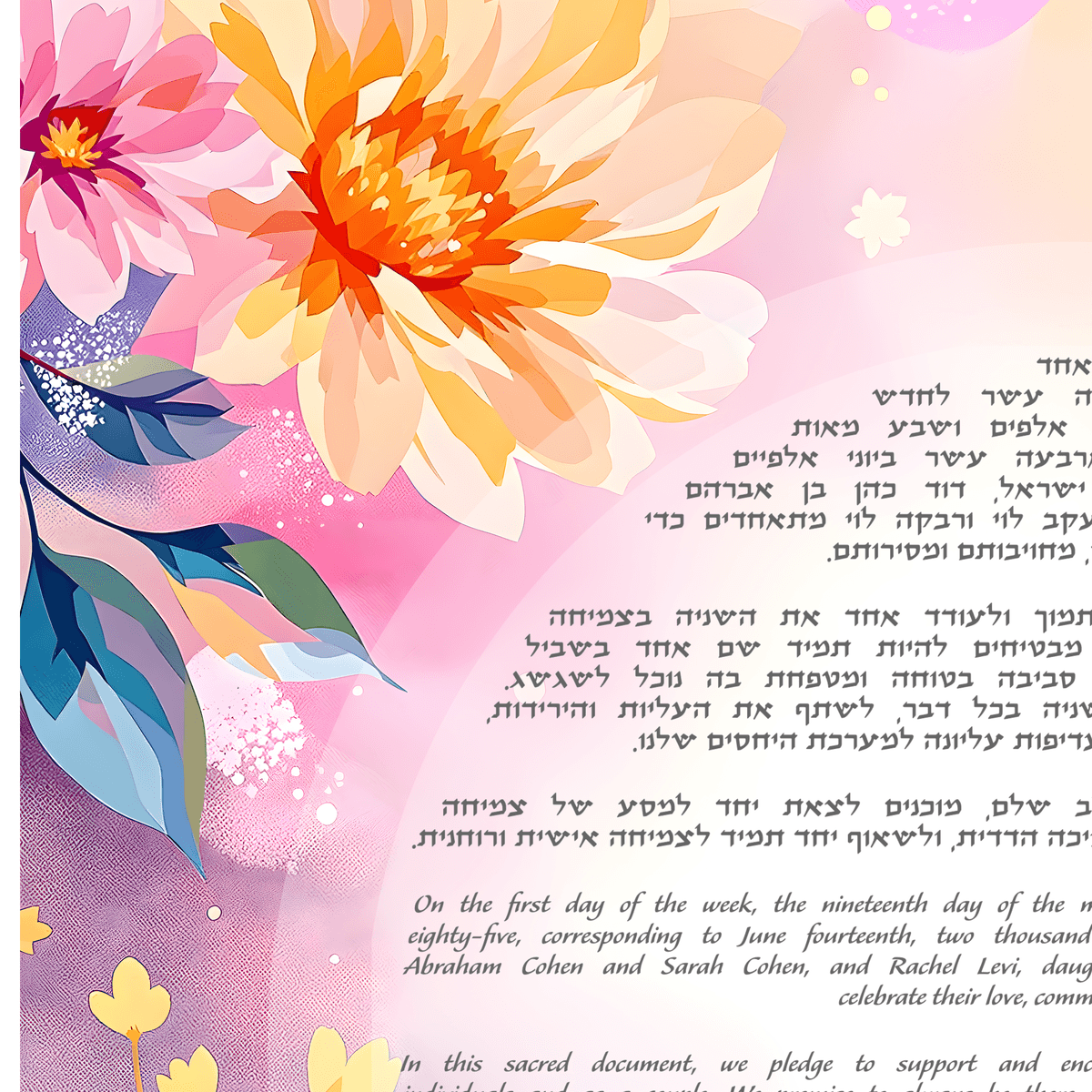
This is a growing middle tier. Instead of choosing from a catalog, you describe what you want, such as a color palette, a theme, or specific motifs, and the artwork is generated fresh from that description. You can usually see several options, adjust them, and add your own text and names before you buy. Prices tend to sit in the same range as personalized prints, and the main difference is that the art starts from your ideas rather than someone else's catalog. On Diyo/Art, for example, designing costs nothing, a high-resolution digital file is $149, and an archival print with the digital file included runs from $241 to $405, depending on the size and whether you choose fine art paper or stretched canvas.
Hand-Painted Commissions
At the top of the range is a ketubah painted by hand, just for you. An artist works with you on the concept, paints the piece, often on heavy cotton watercolor paper, and then either hand-letters the text in Hebrew calligraphy or prints it onto the finished painting. Many artists add gold or rose-gold leaf by hand, which catches the light in a way no print can quite match. This is also where the most personal requests land. Artists regularly paint a couple's first apartment, the trail where they got engaged, or even their rescue dogs, sometimes with real paw prints worked in near the signatures.
What a Custom Ketubah Costs
Price follows labor. A personalized print or an AI-generated design is mostly about the text and the printing, so it stays in the low hundreds. A hand-painted commission represents days of an artist's work, and the price reflects that. Original commissions commonly start in the high hundreds and can run well past $1,000 for large pieces, intricate detail, or heavy gilding. Some artists offer a middle route: a painting they've already made, reproduced as a print with your text added. You get a hand-painted look at closer to a print price.
A few things push the price of a commission up:
- Size. A larger painting takes longer and costs more to frame later.
- Gilding. Genuine gold leaf costs more than imitation leaf and never tarnishes. Imitation leaf looks just as bright at first but can dull over the years unless it's sealed. Ask which one you're getting.
- Calligraphy. Hand-lettered text takes far longer than printed text, and a single slip can mean redoing a section.
- Revisions. Most artists include a sketch round or two. Changes after painting begins usually cost extra.
How to Find a Ketubah Artist
Searching for a ketubah artist near you will turn up some local names, but most ketubah artists work remotely, and plenty never meet their couples in person. Good places to look include marketplaces like Etsy, artists' own websites, Judaica shops, and your rabbi or officiant, who has seen a lot of ketubot signed and usually has opinions. Many artists also share their process online, and watching someone take a piece from pencil sketch to final gold leaf tells you a lot about how much care goes into it.
Before you commit, ask:
- Can I see photos of finished, signed ketubot, not just the artwork?
- Who writes and checks the Hebrew text?
- What paper and inks do you use, and what pen should we sign with?
- What's the schedule, how much is the deposit, and what happens if either of us needs to cancel?
- How many rounds of changes are included?
The pen question matters more than it sounds. Textured watercolor paper is beautiful, but some inks feather on it. A good artist will tell you exactly what to bring, or test it on a scrap of the same paper.
Where the Text Comes From
Ketubah artists are painters first. Some keep a library of texts and work with a Hebrew calligrapher or translator they trust. Others expect you to supply the wording, ready to go. Find out which kind of artist you're working with before you pay a deposit.
If your officiant has a text they prefer, get it from them in writing and pass it on. If you're writing your own, finish it before painting begins. Either way, have your officiant review a proof with your names, your parents' names, and your date filled in before anything is lettered. A typo in hand calligraphy can't be fixed with a quick reprint.
If you're designing on Diyo/Art, the Text & Editing tab lets you choose a text by tradition or write your own, and the Email this text button sends it to your officiant for review before you order.
How the Ordering Process Works
For most ketubah vendors, the process follows a standard shape: choose a design, submit your details, receive a digital proof within a few days, review and request changes, approve, and then the finished piece ships or arrives as a file. This applies whether you're ordering a personalized print or an AI-generated design.
For a hand-painted commission, the process starts earlier and involves more back-and-forth. The artist typically wants an intake conversation first — understanding what you're envisioning, what symbols or motifs matter to you, what size and format you need. After that, they'll share sketches or a design concept for approval before any painting begins. Clarify how many revision rounds are included and what additional rounds cost, before you've signed anything.
The Proof Stage: Don't Rush It
The digital proof is the most important step in the ordering process, and it's the one couples most often rush. It's your last opportunity to catch errors before they're permanent. When you receive a proof:
- Check that every Hebrew name is spelled correctly. If you're not certain, ask someone who reads Hebrew — or verify against a document where you've confirmed the spelling already.
- Confirm the wedding date, including the Hebrew date if your ketubah includes one.
- Read the English text slowly. What looks right at a glance often resolves into an error when you actually read the words.
- Look at the layout — where text sits relative to the art, whether anything feels off in the composition.
Most vendors allow at least one revision round. If you have multiple concerns, address them all in one message rather than going back and forth sequentially — it keeps the timeline cleaner and makes sure nothing gets missed between rounds.
How Far Ahead to Order
Work backward from the wedding, and aim to have the finished ketubah in hand at least two weeks before the day.
- Personalized prints: two to three weeks to produce, plus shipping. Ordering two to three months out leaves room for proof corrections.
- Diyo/Art: digital files are ready right after checkout, and prints arrive in about 15 business days.
- Hand-painted commissions: many artists book months in advance, especially for spring and summer weddings. Start conversations four to six months ahead, and earlier if you have your heart set on one particular artist.
When a Vendor Goes Quiet
Most ketubah artists are one-person studios. Illness, a family emergency, or a busy season can stall a commission, and silence close to your wedding date is genuinely stressful. If it happens:
- Reread your agreement. Note the promised delivery date and what it says about delays and refunds.
- Reach out in writing on every channel you have, email, the marketplace's messaging, and social media, and give a specific date you need to hear back by.
- Ask for a progress photo. It's a fair request, and it tells you quickly whether the piece exists.
- Check your protections. If you paid through a marketplace or by credit card, look into its purchase protection before the deadline to file passes.
- Set a backup date. Around a month before the wedding, decide what you'll sign if the piece hasn't shipped.
The backup doesn't have to be elaborate. A simple printed ketubah with your finished text works for the signing, and many couples sign their artwork later when it arrives. Your officiant can tell you how they'd like to handle it.
Signs That a Vendor Is Reliable
A few things worth checking before you place an order:
- Reviews that specifically mention the proof process. General praise is hard to evaluate. Reviews that describe the back-and-forth, the turnaround times, and the accuracy of the final product tell you something real about the experience.
- A stated turnaround window. Not "we'll be in touch" but a specific timeline from order to proof and proof to ship. Vendors who have thought through their own process can usually tell you what it is.
- Pre-sale response time. If a seller takes five days to answer a question before you've spent any money, that pattern rarely improves after. Responsive communication before the sale is a reasonable proxy for the rest.
- A clear policy on production errors. Ketubahs are personalized, so most vendors don't accept returns. A good vendor will reprint if there's a production error on their end — and will say so clearly before you ask.
The ketubah is one of the few things from your wedding meant to stay with you permanently. A vendor who understands that usually shows it in how they handle the details, well before the piece ships.
Choosing the Kind That Fits
There's no wrong tier. A catalog print gets you a beautiful, proven design with very little effort. A generated design starts from your own ideas at a print price. A commission gives you a painting no one else has, with the time and cost that come with it. Decide what matters most to the two of you, whether that's budget, timeline, or the dogs in the corner, and the right option usually becomes obvious.
The Ketubah You Want, at a Price That Works
For a long time, a ketubah that truly reflected the two of you meant choosing between someone else's catalog design and a commission that could run past $1,000. Diyo/Art closes that gap. You describe the colors, symbols, and mood you love, pick an art style, and see four designs at a time, then recolor, remove, or replace parts of the artwork until it feels right. Designing is free, so you only pay once you love it. A high-resolution digital file is $149, and an archival print with the file included runs from $241 to $405, with free shipping to the continental US and Canada.